
The Science of Post-Harvest Freshness | Green Life Farms
In the commercial agricultural industry, the quality of a vegetable is often judged by its appearance on the retail shelf. However, the true determining factor of quality is decided in the critical hours immediately following the harvest. At Green Life Farms, we recognize that growing a premium crop is only half the battle; the other half is a sophisticated, high-stakes race against biological degradation.
For a grower-shipper operating at scale, “freshness” isn’t a vague marketing term—it is a measurable result of thermal dynamics and atmospheric control. Through the use of advanced cooling technologies and a rigorous cold chain, we ensure that our diverse catalog—ranging from Asparagus and Broccoli to Celery and Leafy Greens—retains its peak nutritional value, structural integrity, and crispness from the field to the final destination.
The Science of the “Cold Chain”
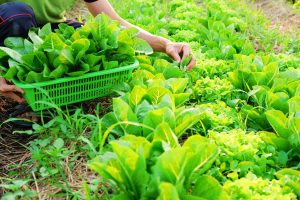
The moment a vegetable is harvested, its “respiration rate” spikes. It begins to consume its own stored energy, leading to wilting and loss of nutrients. We stop this clock through advanced “Pre-cooling” methods tailored to the specific physiology of each crop, especially for our high-demand items like Radishes and Green Onions.
Vacuum Cooling: The Gold Standard for Greens
For leafy greens and slender root vegetables like Green Onions, Kale, and Cilantro, we utilize industrial-grade vacuum cooling. By placing the produce in a sealed chamber and reducing the atmospheric pressure, we force a tiny amount of the plant’s moisture to evaporate. This evaporation rapidly pulls heat from the very center of the pallet. Within minutes, the field heat is gone, locking in the crisp texture and vibrant white-to-green shanks of our onions.
Hydro-Cooling and Icing: Preserving the Snap
For denser commodities like Radishes and Asparagus, vacuum cooling isn’t enough. We utilize hydro-cooling—showering the produce with ice-cold, food-safe water. This method ensures our radishes remain firm and peppery, preventing the “pithiness” or softening that can occur in less-controlled environments.
Precision Storage: Every Degree Matters
Logistics doesn’t end at the cooling shed. Our storage facilities are zoned by commodity. Most cruciferous and root vegetables are held at a constant 0–2°C (32–36°F).
For our Green Onions, we maintain a 98% to 100% relative humidity level to prevent dehydration of the clipped ends. For our Radishes, consistency is key to maintaining their vibrant red skin and crunchy interior. Even a two-degree deviation can result in a 20% loss in shelf life. By mastering these variables, we ensure that our produce arrives at its destination as if it were harvested that morning.
Technical Specifications: Storage & Handling
To help our retail and wholesale partners maximize their inventory, we provide the following storage benchmarks for our primary crops:
| Product Variety | Ideal Storage Temp | Humidity Level | Cooling Method |
| Green Onions | 0°C (32°F) | 98-100% | Vacuum Cooling / Icing |
| Radishes | 0°C (32°F) | 95-100% | Hydro-cooling / Room Cooling |
| Asparagus | 0° – 2°C (32° – 36°F) | 95-100% | Hydro-cooling |
| Broccoli / Cauliflower | 0°C (32°F) | 95-100% | Icing / Forced Air |
| Kale / Leafy Greens | 0°C (32°F) | 95-100% | Vacuum Cooling |
| Mini Watermelons | 7° – 10°C (45° – 50°F) | 85-90% | Room Cooling |
Food Safety: Our “Field-to-Shed” Philosophy
Transparency is non-negotiable. Our food safety protocols are designed to exceed GlobalG.A.P. and FSMA standards.
Expert Packers and Rigorous Sorting
Safety starts with the hands that pick the crop. For our Green Onions, we harvest based on precise base-plate diameters (1/4 to 1/2 inch) to ensure uniformity. Our Radishes are carefully washed and sorted to eliminate any with growth cracks or defects before they ever hit a shipping container. We operate under a “minimal touch” philosophy to reduce the risk of contamination.
Full Traceability
Every carton leaving our facility carries a digital footprint. In the rare event of a quality concern, we can trace a single box of green onions back to the specific field, the specific day, and the specific crew that harvested it.
Removing Field Heat: The Critical First Hour
The moment a vegetable is harvested, it begins a process of deterioration. The “respiration rate”—the process by which a plant consumes its own stored sugars and releases heat—increases significantly once it is separated from its root system. If this internal “field heat” is not removed immediately, the vegetable will wilt, lose its nutrient density, and suffer a drastically shortened shelf life.
We utilize two primary, scientifically distinct methods to stop this biological clock:
Vacuum Cooling: Precision for Leafy Greens
For high-surface-area crops like Cilantro, Kale, Green Onions, and Italian Parsley, vacuum cooling is the gold standard. We place entire pallets into a sealed steel chamber and reduce the atmospheric pressure. As the pressure drops, the boiling point of water also drops. This forces a tiny fraction of the moisture within the plant to evaporate, which rapidly pulls heat from the very center of the produce.
Within 20 to 30 minutes, the internal temperature of a pallet can be dropped from 80°F to 34°F. This process is far superior to standard refrigeration because it cools the product uniformly from the inside out, preventing the “sweating” and bacterial growth common in slower cooling methods.
Hydro-Cooling: Protecting the Snap
For denser commodities like Asparagus, vacuum cooling is less effective because moisture cannot evaporate quickly enough from the thick stalks. Instead, we utilize hydro-cooling. By showering the spears with chilled, food-safe water (near 32°F), we remove field heat far faster than air cooling alone.
This method doesn’t just cool; it rehydrates. Asparagus is prone to “toughness” if it loses moisture. Hydro-cooling preserves the “snap” and prevents the woody texture that often plagues lower-quality shipments.
Specialized Humidity and Temperature Zones
One of the most complex challenges for a large-scale grower-shipper is managing a diverse inventory. Storing Mini Watermelons in the same environment as Green Cabbage can lead to chilling injuries or premature spoilage. Our facility is meticulously zoned to provide the exact micro-climate required for each of our 20+ varieties.
High-Humidity Management (95–100%)
Vegetables like Celery, Spinach, and Leeks are composed largely of water. In a standard dry-air cooler, these items would lose weight and crispness within hours. We maintain near-saturation humidity levels in our storage zones to prevent transpiration. For our celery, this ensures the stalks remain heavy and turgid, providing the premium crunch that retailers expect.
The “Zero Degree” Standard
Most of our cruciferous vegetables, including Broccoli and Cauliflower, are held at a constant 0°–2°C (32°–35.6°F). Maintaining this narrow window requires industrial-grade HVAC systems and constant digital monitoring. Even a two-degree deviation can result in a 20% loss in shelf life. By mastering these variables, we extend the “sell-by” window for our partners, reducing shrink and increasing profitability.
The Role of Precision Packing and “Expert Hands”
Technology is only as effective as the people operating it. Our expert packers play a vital role in our logistics chain. By field-packing many of our items, we minimize the “touches” each vegetable receives. Every time a piece of produce is handled, there is a risk of mechanical bruising or microbial transfer.
- The 9-Inch Asparagus Standard: Our asparagus is not just picked; it is engineered for the shelf. We harvest at a precise 9-inch length, ensuring the stalks are tender. They are packed in ventilated, pyramid-shaped boxes with soaked pads at the base. These pads act as a reservoir, allowing the asparagus to “drink” during transit, which maintains the tip integrity.
- Root Crop Care: Our Beets are handled with specific care to protect the skin. Whether bunched at full-length or topped per client specs, they are quickly moved to a room-cooling environment to preserve their earthy sweetness and firm texture.
Digital Traceability and GlobalG.A.P. Compliance
In 2026, a “Science of Freshness” approach is incomplete without data. Food safety and quality assurance are now inextricably linked to digital transparency. Our digital traceability system allows us to monitor the cold chain in real-time, providing an unbroken record of a product’s journey.
Every carton is assigned a unique digital ID. In the event of a quality inquiry, we can instantly identify:
- The exact field and row the product was harvested from.
- The time it entered the cooling chamber and the duration of the cool-down.
- The specific crew and packer responsible for the carton.
- The temperature of the transit vehicle during delivery.
This level of accountability ensures that our Conventional and Organic varieties meet the highest standards of GlobalG.A.P. and FSMA compliance. For our B2B partners, this isn’t just “good farming”—it is risk management.
Bridging the Gap: From Field to Fork
The grower-shipper model is built on the philosophy that the faster we can move produce from the soil to a temperature-controlled environment, the better the end-user experience. By owning the cooling and shipping infrastructure, Green Life Farms eliminates the “middleman” delays that often compromise produce quality.
Whether we are shipping high-volume Green Beans, specialty Mini Watermelons, or our staple Radishes and Green Onions, the goal remains consistent: to use science to protect the natural excellence of our crops. We don’t just grow vegetables; we engineer a more reliable, safer, and higher-quality produce experience for the global market.